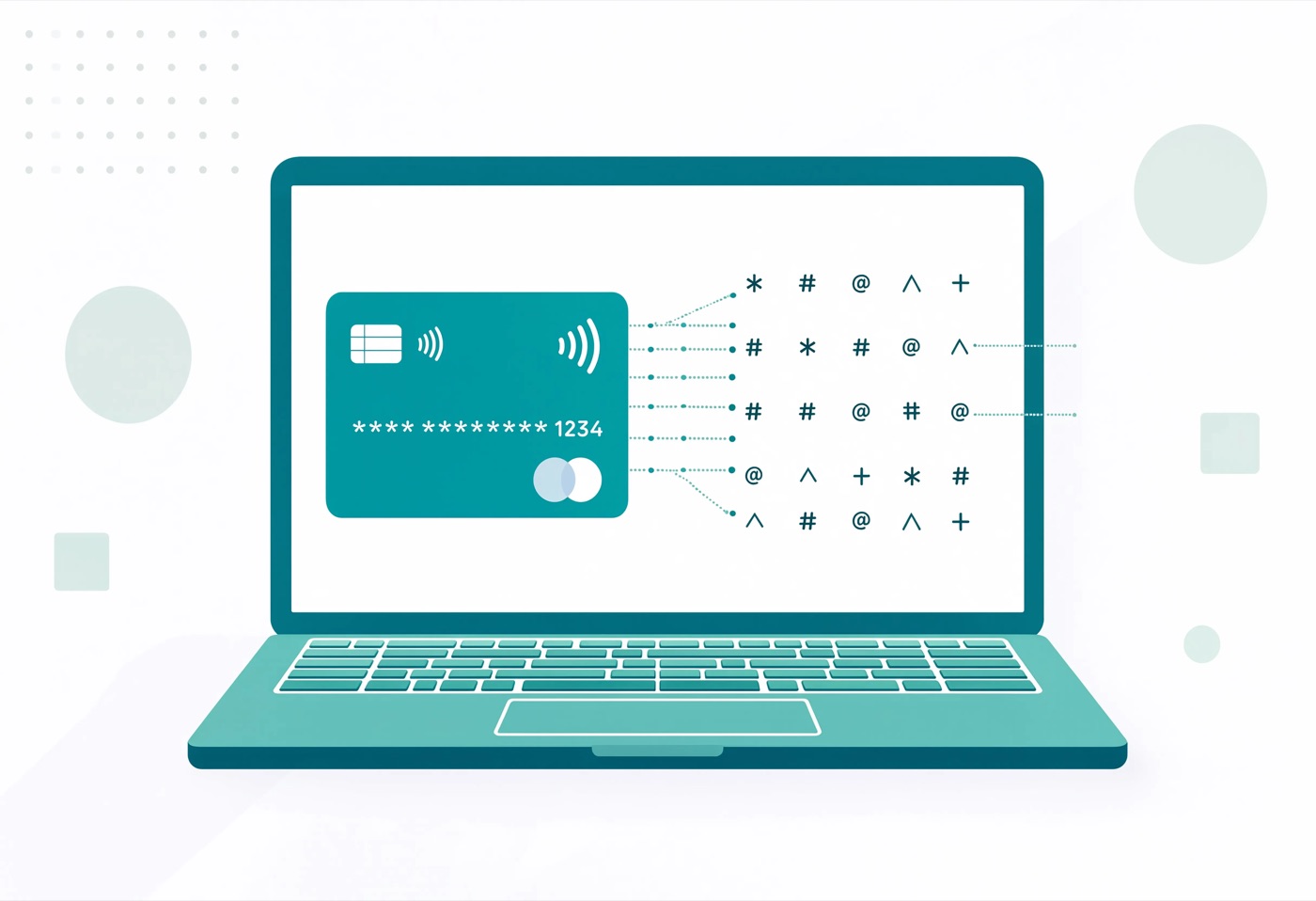
Tokenization is the invisible mechanism that lets your business take card payments securely, charge customers again later without storing sensitive data, and stay on the right side of PCI compliance – all without building any security infrastructure yourself. Understanding what it is and how it works tells you which questions to ask your payment provider and which setups to avoid.
Key takeaways
- Tokenization replaces sensitive card data with a valueless substitute string – your systems hold references to cards, not the cards themselves.
- Unlike encryption, a token has no mathematical relationship to the original card number, so there is nothing to unscramble if your database is breached.
- Network tokenization auto-updates stored payment methods when cards are reissued, cutting involuntary churn on subscription and recurring billing.
- Keeping raw card data off your servers significantly shrinks your PCI DSS compliance scope and the cost of any security audit.
- Before choosing a provider, confirm they return a usable token, support network tokenization for renewals, and hold a PCI DSS Level 1 certification.
The first time someone explains tokenization to you, it usually sounds like one of those topics you can safely ignore. Some security thing your payment provider handles in the background. Not your problem.
Then a card on file gets reissued, your subscription renewals start failing, and suddenly you’re losing customers you already won. Or your auditor asks, casually, where exactly you store card numbers – and you realise you don’t actually know. So let’s answer the obvious question first: what is tokenization, and why does it quietly decide so much about how smoothly your business takes money?
What Is Tokenization, Really?
Tokenization is the process of swapping sensitive data – usually a credit card number – for a substitute string of characters called a token. The token looks a bit like the original (it might keep the last four digits, for example), but it has no value on its own. If a thief grabs it, they can’t do anything with it. The real card number is locked away in a secure vault you don’t have to manage.
Think of it like a coat check. You hand over your coat and get a numbered tag. The tag is useless to anyone except the cloakroom that issued it. The coat never leaves the locked room.
In payments, the “coat” is the cardholder data. The “tag” is the token. Your CRM, your invoicing tool, your database – they all hold tags, not cards. When it’s time to charge the customer again, your payment provider trades the tag back in for the real card behind the scenes.
Tokenization vs Encryption – They’re Not the Same Thing
People mix these up constantly, so it’s worth being precise.
Encryption scrambles data using a key. Anyone with the right key can unscramble it back to the original – the data is hidden, but mathematically it’s still there.
Tokenization replaces the data entirely. The token has no mathematical relationship to the card number; it’s just a reference to where the real number is stored. Without access to the vault, there’s nothing to “unscramble” because the token isn’t an encrypted card. It’s a pointer to one.
Modern payment platforms use both. Encryption protects data while it’s moving across networks. Tokenization protects data while it’s sitting in your systems.
How Payment Tokenization Works in a Real Flow
Here’s what happens the first time a customer pays you online:
- The customer enters their card details on your checkout page.
- Those details go straight to your payment provider – ideally without ever touching your own servers.
- The provider stores the card in a secure vault and sends you back a token (something like
tok_4f9b-0123). - You save that token against the customer’s record.
- Next time you charge them – a renewal, a top-up, a one-click reorder – you send the token, not the card.
That’s the whole loop. Your database now contains references to cards, not the cards themselves. Even if someone breaches your systems, the data they walk away with isn’t useful.
There’s also a more advanced flavour of card tokenization called network tokenization, where the card networks themselves (Visa, Mastercard, and so on) issue the token. The clever part: when a customer’s physical card is reissued or expires, the network can update the token automatically. Your saved payment methods keep working without anyone having to retype card details. For subscription businesses, that single feature pays for itself many times over.
Why Tokenization Matters for Your Business
If you’ve made it this far, you might still be thinking: fine, but is this actually my problem?
Here are the practical reasons it is.
It shrinks your PCI compliance scope. Per the PCI Security Standards Council, PCI DSS applies to wherever cardholder data lives in your systems. If card numbers never touch your servers, large parts of your environment fall out of scope. That means less paperwork, cheaper audits, and less risk if anything goes wrong.
It cuts the cost of a breach to roughly nothing – at least the card-data part. You can’t lose what you don’t store. Customers, journalists, and regulators treat “tokens leaked” very differently from “card numbers leaked”.
It makes recurring revenue more reliable. Network tokens get updated automatically when cards are reissued. For any business with subscriptions, retainers, or stored payment methods, that translates directly into fewer involuntary churns.
It enables features customers actually like. One-click checkout. Save-card-on-file. Easy refunds without re-prompting for details. None of those are possible without tokens in the background.
It future-proofs omni-channel selling. If you take payments online today and want to add an app or in-person sales later, tokens travel with the customer across every channel – no re-entering cards.
How to Make Sure Your Setup Uses Tokenization Properly
You don’t need to build any of this yourself. What you do need is to confirm a few things about whoever you’re working with.
- Are card details collected by the payment provider, not your own servers? Hosted checkout pages, payment links, and iframe-based fields keep raw card data out of your environment. If anyone is posting card numbers to your backend, that’s a red flag.
- Do you get a token back you can safely store? A token is what lets you charge the same customer again without storing the card. Make sure the provider returns one and documents how to use it.
- Does it support network tokenization for the schemes you accept? Crucial for recurring billing or saved cards. Ask whether tokens auto-update when cards are reissued.
- Is the vault PCI DSS Level 1 certified? That’s the highest tier per the PCI Security Standards Council and the standard for any serious payment platform. The certification belongs to the provider – which is exactly the point.
- Can the same token work across channels? If you might add app or in-person sales later, you want tokens that move with you, not data locked into a single product.
If any answers are fuzzy, push for clarity before you scale. Migrating tokens between providers is technically possible but operationally painful.
For deeper background, the PCI Security Standards Council publishes the official tokenization guidance, and the Wikipedia entry on tokenization (data security) gives a solid technical overview.
Putting It All Together
So, what is tokenization? The short answer: it’s the invisible trick that lets your business take cards securely, charge customers again later, and stay on the right side of compliance – without ever holding the sensitive data yourself.
The longer answer is that it quietly underpins almost every modern payment experience you actually want. One-click reorders. Subscription renewals that don’t fail when a card expires. Audits that don’t take six weeks. Checkout flows you can build without panicking about where the data lives.
If you’re rebuilding your checkout or tired of patching together a payments stack, choose a provider that treats tokenization as a default, not an upgrade. ONE Payments is built around exactly that – an all-in-one platform that lets you accept Visa, Mastercard, Amex, JCB, and UnionPay, store tokens safely, and simplify payments across every channel you sell on, the cost-effective way.